An entryway provides the first glimpse of a home’s personality. Before visitors notice the living room furniture, kitchen finishes, or carefully styled shelves, they encounter the artwork, colors, and details placed near the front door.
Despite its visual importance, this area is often treated as a passage rather than a room. Shoes, bags, keys, mail, and coats may be stored in practical storage, while the walls remain undecorated or hold artwork chosen with little consideration.
Thoughtful entryway wall art can transform that transitional space into a welcoming introduction. The goal is not simply to fill an empty wall. Instead, use artwork to establish a mood, create direction, and offer a small preview of the style found throughout the rest of your home.
These entryway wall art ideas will help you create a memorable first impression while making the space feel organized, personal, and complete.
Decide What Your Entryway Should Communicate
Begin by considering how you want to feel when you arrive home.
Some entryways should feel calm and restorative after a busy day. Others benefit from cheerful colors, energetic graphics, or artwork that immediately expresses the homeowner’s interests.
Choose three words that describe the impression you want to create. Your words might be:
- Warm, collected, and nostalgic
- Bright, playful, and welcoming
- Calm, natural, and uncluttered
- Artistic, dramatic, and sophisticated
- Colorful, retro, and expressive
This short exercise provides a clearer direction than trying to match artwork to every object in the space.
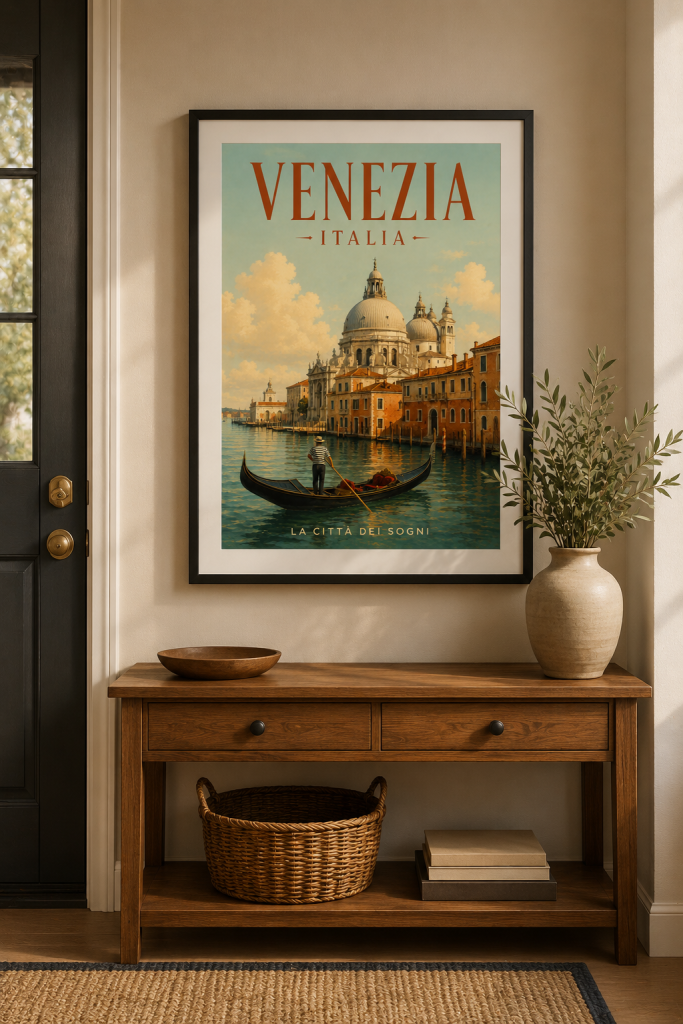
For example, a peaceful entrance might feature botanical illustrations, soft landscapes, or minimal photography. Retro travel posters, music-inspired designs, fashion prints, or colorful typography can create a livelier welcome.
Artwork near the door functions almost like a book’s cover. It does not need to reveal everything, but it should encourage people to discover more.
Study the View From the Open Door
Entryway artwork should be evaluated both from outside the space and from within it.
Open the front door and stand where a visitor would naturally pause. Notice which wall becomes visible first, whether furniture blocks the view, and how the artwork might appear from the hallway or porch.
That initial sightline is usually the strongest location for a statement piece. One medium or large printable can create more impact than several small designs scattered across unrelated surfaces.
Next, walk farther into the home and look back toward the entrance. Artwork that remains visible from both directions can connect the entryway with a nearby living room, staircase, or open floor plan.
Homes with connected spaces require additional coordination. Please read How to Choose Wall Art for an Open-Concept Home for guidance on creating visual relationships without making every room look identical.
Match the Artwork to the Wall’s Shape
Entryways frequently contain unusual wall proportions. Narrow surfaces, tall stairway walls, shallow corners, and spaces interrupted by doors or light switches require more careful planning than a large rectangular living room wall.
A tall, narrow wall may suit a vertical print, stacked pair, or three smaller pieces arranged in a column. Horizontal artwork works well above a bench, shoe cabinet, or long console table.
Compact entrances often benefit from one confident design with generous negative space. Too many small frames can make a limited area feel crowded, particularly when coats, mirrors, baskets, and storage accessories are also visible.
Large foyers can support an oversized print, a coordinated pair, or a carefully edited gallery arrangement. Allow enough open wall around the display so that the artwork feels intentional rather than squeezed into place.
Before selecting a file size, please check out the Printable Wall Art Size Guide. It explains common aspect ratios and helps prevent accidental cropping or distortion.
Create a Welcoming Moment Above a Console
A console table provides an entryway with a natural decorative anchor. Artwork positioned above it can visually connect practical items such as a lamp, key tray, vase, or storage basket.
Aim for a composition that feels balanced without becoming perfectly mirrored. Place the largest artwork slightly off-center, then use a lamp or a taller accessory on the opposite side to balance the visual weight.
Keep functional objects under control. Mail, sunglasses, chargers, and loose keys can quickly distract from an attractive display. A small decorative box or lidded container provides a place for everyday necessities while preserving a polished appearance.
The artwork should normally be narrower than the furniture beneath it. Displays that extend far beyond the console on both sides may appear top-heavy or disconnected.
For an elevated finish, repeat one color from the print in a nearby accessory. That connection might appear in a ceramic bowl, book cover, lampshade, or small vase.
Use a Mirror and Artwork Together
Mirrors are practical in an entryway because they reflect light and provide a convenient place for a final check before leaving home. However, a mirror does not need to replace artwork.
Position a narrow-framed print beside a round mirror, place two small designs beneath it, or create an asymmetrical arrangement that includes both elements.
Different shapes can add interest. A circular mirror softens the straight lines of rectangular frames, consoles, doors, and storage cabinets.
Avoid surrounding a highly decorative mirror with too many detailed prints. When the mirror has an ornate frame, select artwork with cleaner compositions or simpler framing.
Consider what the mirror reflects as well. Ideally, it should capture an attractive part of the home, natural light, or a thoughtfully styled wall rather than an overflowing coat rack.
Choose Artwork That Can Handle Close Viewing
Unlike artwork displayed across a large living room, entryway prints are often viewed from only a few feet away.
Fine illustration, expressive typography, vintage advertising details, architectural drawings, photography, and textured digital artwork can work especially well at this distance. Visitors may notice details that would disappear when viewed from across a larger room.
Print quality becomes more noticeable too. Use the original high-resolution file and select the correct ratio for the intended frame.
Paper with a matte or lightly textured surface can reduce glare from nearby lamps and overhead lighting. Crisp borders, clean glazing, and accurately cut mats also improve the presentation.
Please read How to Make Printable Wall Art Look Expensive for practical ways to elevate digital artwork through paper, scale, framing, and placement.
This post contains affiliate links, which may support the site at no extra cost to you.
Let the Entryway Introduce Your Story
Generic décor can make an entrance look finished, but personal artwork makes it memorable.
Consider prints connected to places you have visited, cities you love, music that matters to you, cultural references, favorite decades, or creative interests. Vintage travel art might recall a meaningful destination, while retro photography can introduce a love of cameras and visual history.
The artwork does not need to match every room. Instead, select one idea that appears again elsewhere in the home.
A black frame near the front door might coordinate with the black hardware in the living room. Muted orange in a retro poster could reappear in a cushion or dining chair. Botanical imagery may connect the entryway to plants placed throughout the house.
This gentle repetition creates continuity while allowing each space to retain its own identity.
For additional guidance on coordinating artwork with furniture and surrounding décor, please check out How to Choose Wall Art for Your Living Room.
Adapt the Display for a Small Entryway
Limited wall space does not mean the entrance must remain undecorated.
Use a slim frame beside the door, display a small print on a floating shelf, or lean framed artwork on top of a narrow shoe cabinet. Even an 8 x 10-inch design can contribute personality when its scale suits the surrounding area.
Vertical space is particularly valuable. Stacking two prints draws the eye upward without requiring a wide wall.
Keep the palette controlled when the entryway already contains visible storage. One strong color, one supporting shade, and a neutral frame can create impact without adding visual clutter.
Renters may prefer removable picture-hanging strips, tabletop frames, or lightweight artwork displayed on narrow ledges. Always confirm the product’s weight limit and test removable adhesives in an inconspicuous area.
Test the Arrangement Before Hanging Anything
Planning prevents unnecessary holes and awkward spacing.
Trace each frame onto paper, cut out the shapes, and attach the templates to the wall with painter’s tape. Step back, open the door, and view the arrangement from several nearby rooms.
Pay attention to the artwork’s center height, its relationship to furniture, and any interference from light switches or door movement.
Another useful method involves photographing the blank wall and placing digital rectangles over the image. This quick mockup makes it easier to compare vertical, horizontal, and grouped arrangements.
Allow the templates to remain in place for a day before installing the frames. Living with the proposed layout often reveals spacing problems that are not obvious during the initial setup.
Make Your First Impression Feel Personal
The best entryway wall art ideas do more than decorate the area beside the front door. They introduce the home’s atmosphere, express something about the people who live there, and create a more enjoyable arrival at the end of each day.
Begin with the main sightline, choose artwork that suits the wall’s proportions, and consider how the display appears from adjoining rooms. Use framing, scale, and a few repeated colors to connect the entrance with the rest of the home.
Most importantly, select artwork that feels meaningful. A thoughtfully chosen printable can turn even a narrow hallway or compact apartment entrance into a welcoming space with character.
Browse more printable vintage wall art and discover unique retro-inspired designs at THEARTREVERIESHOP.COM, where downloadable artwork makes it easy to create a stylish first impression without waiting for physical artwork to arrive.
Discover more from The Art Reverie Shop
Subscribe to get the latest posts sent to your email.